
Patients looking for better questions
If you have lived with chronic pain, arthritis, tendon injury, or a degenerative condition, the book is a foundation for asking about emerging options, their limits, and the evidence behind them.
A book by Dr. Jeffrey Piccirillo
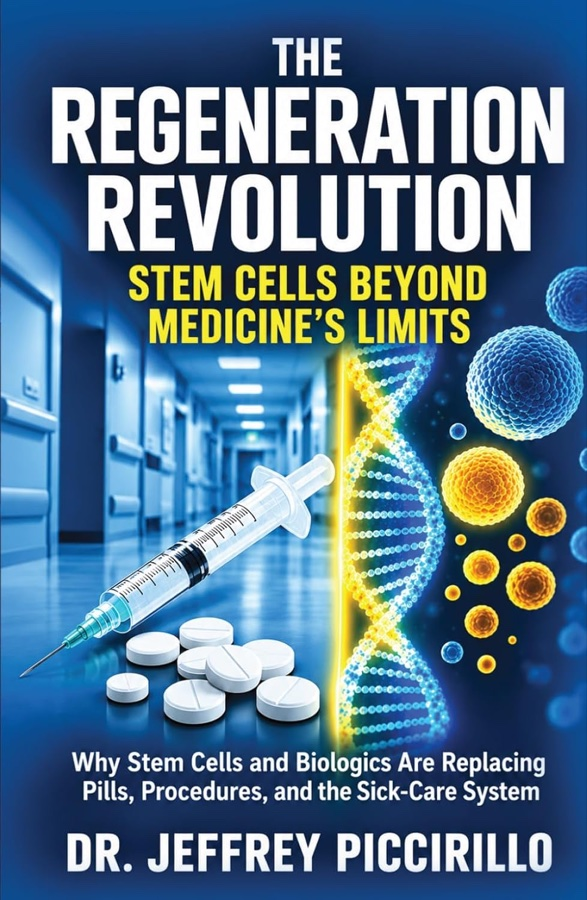
Stem Cells Beyond Medicine’s Limits
What if the future of medicine isn’t simply about treating disease, but helping the body heal?
A question that would not go away
For more than 30 years as an orthopedic surgeon, Dr. Jeffrey Piccirillo has watched modern medicine become extraordinarily good at what it set out to do. Surgical technique advanced. Medications learned to control symptoms and manage chronic disease. Diagnosis, imaging, and joint replacement grew more precise.
Throughout that career, one question kept its shape.
What if we could do more than manage the damage? What if we could help the body repair it?
That question led him into regenerative medicine, and then into this book. The future of medicine may not simply be about treating what is broken. It may be about understanding how the body repairs itself and learning how to support that process.
A new way of thinking about healing
We prescribe medication.
We inject a corticosteroid.
We manage the symptoms until surgery becomes necessary.
We recommend rest, therapy, injections, or eventually surgery.
These treatments can be valuable, and sometimes absolutely necessary. They do not always address the biology responsible for tissue damage and impaired healing.
Can we influence the biological environment in ways that help damaged tissue repair itself?
That question is the foundation of The Regeneration Revolution.
The distinction
Healing is not simply a mechanical process.
Healing is a biological process.
The healing potential of the human body
Cells communicate. Damaged proteins are replaced. Inflammatory signals coordinate the response to injury. Blood vessels deliver oxygen and nutrients. Growth factors influence cellular behavior. Stem and progenitor cells take part in maintenance and repair. Through all of it, the body is trying to keep its balance.
Age, chronic inflammation, metabolic dysfunction, oxidative stress, impaired circulation, and extensive tissue damage can interfere with a normal healing response. Regenerative medicine asks whether damaged tissue must always be removed, replaced, or simply tolerated. It also asks whether the repair mechanisms already present can be supported.
Beyond the hype and the headlines
Few subjects in modern medicine have produced so much excitement, and so much misunderstanding. Stem cells have been cast as a breakthrough for serious disease and as a cure for aging. The truth is more complicated, and more interesting.
They can self-renew and, under the right conditions, become specialized cell types. They also interact with surrounding tissue and with signaling pathways. Researchers are studying whether those traits can be used where conventional medicine cannot adequately repair tissue.
Important questions remain unanswered. The book stays with them, and with a line that matters more than the headlines: scientific possibility is not the same thing as proven clinical effectiveness.
Beyond any single cell
Stem cells sit at the center of the conversation. The future of the field reaches further than any one cell type or treatment. Even a promising therapy has to operate inside the biology of the patient who receives it.
The biological properties of stem cells, and where those properties might, and might not, belong in treatment.
How concentrated platelets and their growth factors may influence tissue healing and repair.
How cells communicate and coordinate a response to injury.
Emerging research into the microscopic particles cells use to talk to one another.
Why inflammation is necessary for repair, and why persistent or poorly regulated inflammation gets in the way.
How an imbalance between reactive oxygen species and cellular defenses may contribute to tissue dysfunction.
Why healing capacity changes with age, and how metabolic and biological health shape repair.
Developing technologies, open research questions, and what has to be solved before an emerging treatment becomes established care.
Why I wrote this book
After more than three decades in orthopedic surgery, I have spent much of my professional life with damaged tissue. Torn tendons. Arthritic joints. Injured ligaments. Degenerative conditions. Chronic pain. And the consequences of tissue that has lost the ability to function as it should.
Surgery has an important place. I have seen it change lives. I have also seen its limits. It can repair anatomy, stabilize a structure, and replace a joint. It does not necessarily restore the original biology of the tissue.
That distinction changed the questions I asked. What actually happens during healing? Why do some patients recover remarkably well while others struggle with the same treatment? How much does a patient’s underlying biology decide the result? Could treatment work with the body’s repair mechanisms, rather than only compensating when they fail?
I wrote The Regeneration Revolution because patients and clinicians deserve a clearer account of a field moving quickly. I wanted the science without losing the excitement of what may be possible. I also wanted a distinction kept in plain sight.
Regenerative medicine is not magic. Not every treatment works. Not every claim is supported by good science. And not every emerging therapy is ready for routine clinical use.
Progress takes research, careful patient selection, appropriate oversight, and a willingness to challenge our own assumptions. Still, I believe this is one of the most fascinating frontiers in modern healthcare, because it asks a question medicine has not always been equipped to answer: what if we could help the body do more of what it was biologically designed to do, which is to heal?
Dr. Jeffrey Piccirillo
From replacement to regeneration
For much of medical history, damaged tissue has been met in three ways: reduce the symptoms, repair the structure, replace what can no longer function. All three remain important. Regenerative medicine adds another possibility: influencing the biological processes responsible for repair.
Control pain, inflammation, and the symptoms a patient lives with.
Restore structure. Stabilize what injury has made unstable.
Substitute tissue or a joint that can no longer do its work.
Ask whether the biology of repair itself can be understood and supported.
A damaged knee is not only a mechanical problem. A chronically injured tendon is not only a structural one. Impaired healing is not always explained by how severe the original injury was.
Regenerative medicine cannot be reduced to a single injection, product, or procedure. It requires a deeper understanding of the patient. The future of healing may depend not only on what we put into the body, but on the biological environment we put it into.
Who this book is for
If you have lived with chronic pain, arthritis, tendon injury, or a degenerative condition, the book is a foundation for asking about emerging options, their limits, and the evidence behind them.
A wider view of the mechanisms that influence tissue healing, and a challenge to look past anatomy and symptoms into the cellular environment where recovery actually occurs.
Aging changes cellular function, inflammation, metabolism, and tissue repair. Regenerative biology helps explain why staying well is more than treating disease after it appears.
From stem cells and platelet-rich plasma to cellular signaling and emerging biological therapies, the developments that may shape the next generation of healthcare.
A revolution built on science, not promises
The aim is not to replace skepticism with enthusiasm. It is to hold curiosity and evidence at the same time. Innovation with responsibility. The desire to help patients with an honest account of what medicine can, and cannot, currently do.
Some regenerative approaches already have a place in medical practice.
Others rest on early research that is encouraging and still incomplete.
Many remain experimental, and should be described that way.
The future of this field will not be settled by the boldest marketing claims. It will be settled by good science, meaningful clinical outcomes, and treatments that show a real benefit for patients.
Medicine has had moments that changed what physicians believed was possible. Regenerative medicine may be another, not because it eliminates disease or reverses aging, but because it asks us to understand the mechanisms of healing.
Discover the future of healing
What if the next advance in medicine is not another medication, another surgery, or another way to manage symptoms, but a clearer understanding of the biology of healing itself?
Published October 2, 2026 · Staten House · 316 pages
$21.99
The complete book in print.
Order on Amazon$34.99
A durable edition for the shelf.
Order on Amazon$9.99
Download and start reading.
Order on AmazonBecause understanding how the body heals may change how we practice medicine.
Stay in the conversation
Leave your name and email if you want notes on events, new editions, or related writing. We will not send a stream of mail.
Write to the author
This form reaches the team. It is not a medical consultation and it does not create a patient relationship.